Friday, 14 August 2015
Churchill by rail - Part two: Stranded in Thompson

By Paul Ullrich
We awoke to a steady rain just outside of Cormorant Lake, north of The Pas. It had been raining all night, and it continued to rain until just before we reached Thompson Junction.
This was the land of no roads, no communities, no cell phone transmitters and certainly no wi-fi. We crossed highway 6 outside of Ponton, Manitoba, crossed highway 373 to Norway House north of Dunlop, and we ran parallel with highway 6 from Dunlop to Wabowden, but after that we were on our own in the wilderness of Manitoba's boreal forest. We passed Thicket Portage, which is where the Franklin expedition once stayed (not a good sign of things to come).
We were going a lot slower since we left The Pas. From the dome car you could see each car rise and fall as it rolled over the uneven roadbed. We reached Thompson Junction, confident that we'd cover the 30 miles from there to Thompson in no time.
No so! It took us 2 1/2 hours to get there, which means that we were hurtling down the track at a breakneck speed of 12 miles an hour! On the plus side, we were going slow enough to get some great shots of the Wintering River and the Grass River as we crossed over them.
The Via timetable lists Thompson as a five hour stop. I was wondering what we were going to do there for such a long time. But the train was several hours late arriving, so I thought that our stay would be brief.
So I thought.
The train from Churchill was waiting for us on the wye. When we pulled into the station, that train backed up behind us. Much to our surprise, we found three cars from the states waiting for our train. They had licence plates from Minnesota, Iowa, and California. The had obviously drove up from Winnipeg on highway 6 to meet the train at Thompson.
It's an eight hour drive from Winnipeg to Thompson. By train, it's 24 hours, assuming that it's on time. Highway 6 is a direct route through the Interlake. The Churchill train meanders through Saskatchewan, as Churchill is a grain port, and Saskatchewan is were the trains get the grain.
It would make perfect sense for anyone to drive to Thompson, then take the train the rest of the way to Churchill. It would make perfect sense to anyone except for a railfan. After all, that's 24 hours less spent on a train!
We were told that we'd be facing a delay due to a mandatory rest period for the crew, and that we'd be leaving Thompson at 1 AM. A few of us decided to walk to Thompson for a snack run. Just outside of Wal-Mart, a native man and his family leaving the store noticed our name tags and stopped us.
"I guess you're stuck here for a while because of the washout, right?" He asked.
Huh?
He was telling the truth. When we got back to the train, it was confirmed that there was indeed a washout north on the line. Due to the heavy rains, a beaver dam had been breeched, which washed out part of the track. We were then told that we'd be staying on the train in Thompson overnight, and that we'd be flown out to Churchill the next morning.
Damn those pesky Canadian rodents, and their shoddy construction techniques.
The crew also told us that they'd be going into town for some supplies for the next day. Despite the news about the delay, we were all in good spirits, and we even had a get-together in the observation car that evening. Being in Thompson also meant that folks carrying cell phones could once again get a signal. That's when we found that the story of our washout made the news!
We went to bed that night on the train, looking forward to a better night's sleep after rocking and rolling through the bush the previous night. We slept peacefully, fully confident that Via Rail would take care of all of our troubles and get us to Churchill swiftly.
Boy, were we ever in for a surprise!

Hey, sign painter - you had one job! Couldn't you face that "N" the right way?

Uh, there is track under that train, right? Exactly how long has that train been at that siding?


Wednesday, 12 August 2015
Churchill by rail - Part one
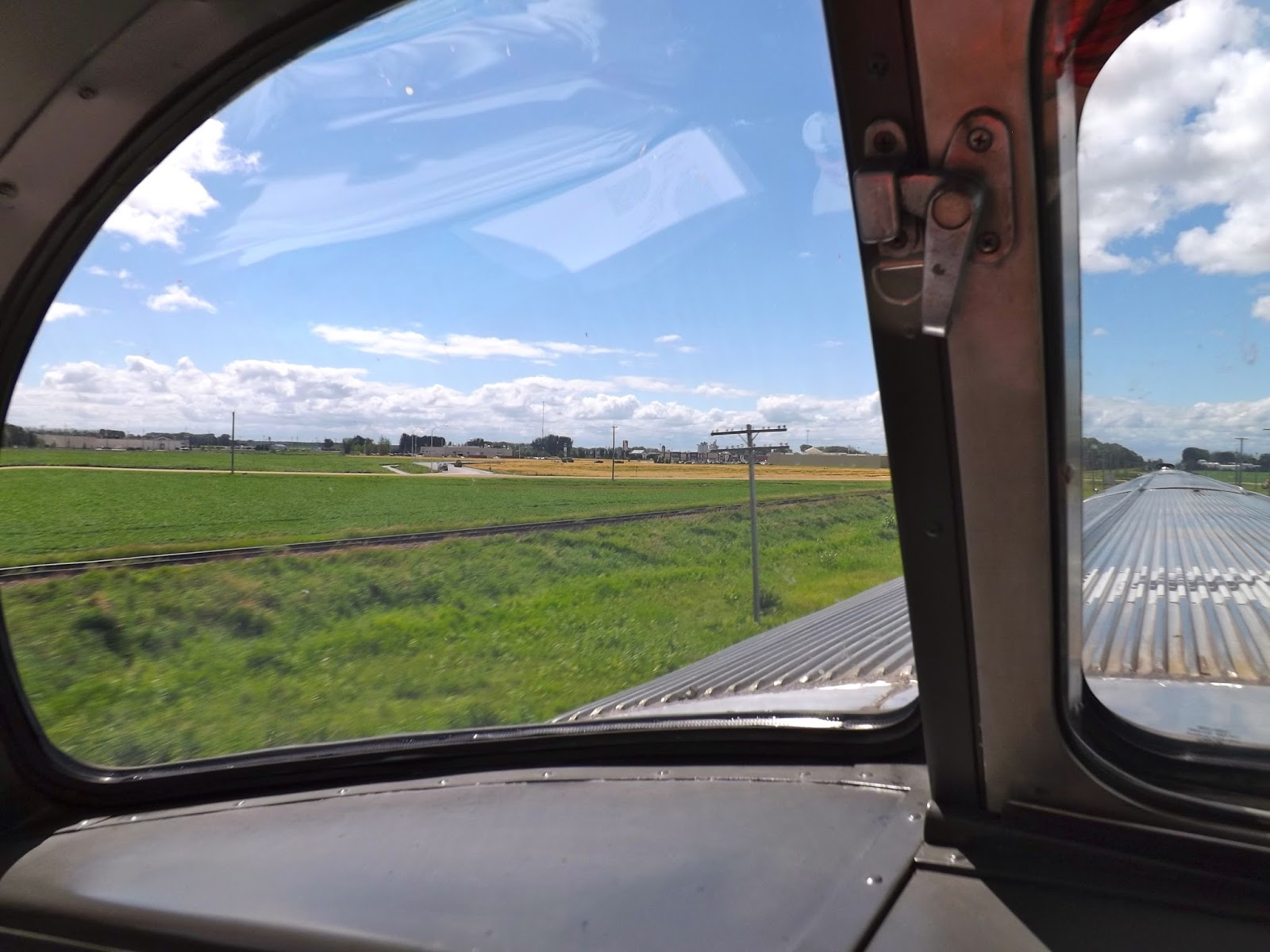
A superb view of the prairie taken from the dome car on the train to Churchill.
This year my wife Margaret and I decided to go whale watching in Churchill, a destination on our bucket list. Being a railfan, I had always wanted to travel there by train. I also wanted to see what northern Manitoba was like, as the farthest north either Margaret and I had ever been in the province was Duck Mountain Provincial Park.
We signed up for the History and belugas of Churchill group tour offered by Rail Travel Tours, which is run by long time WMRC member Daryl Adair. We opted for the upper and lower berths on the train. Not only are they the least expensive sleeping option, but they have the biggest beds, and they're more sociable than being locked away in a room, or in a roomette.
There was a horrendous rainstorm on the morning of our departure, which was so bad that we had our doubts about even getting to Union Station. But 15 minutes before were about to leave, the rain stopped! We were grateful for that, but what we didn't know was that the rain was going to play a significant part in our adventure to Churchill.
We arrived at the station in time to have our luggage checked and to join Daryl's tour of the Winnipeg Railway Museum. Daryl gave a very enjoyable and thorough tour. He's a long time member of the museum, and he knew every piece of rolling stock in the museum inside and out.
The only problem was the heat. Remember that morning's rain? After that downpour, the temperature climbed rapidly, and with all of that extra added humidity, the museum turned into a sauna. It was well before noon when our tour ended, but by the time it was finished we were all dripping with sweat.
When we got back downstairs to the station, we found that the train was running late, as it didn't arrive in Winnipeg until 7:00 that morning (over 14 hours late) and the crew needed more time to get the train ready. Lunch in the car's diner was cancelled, but Via supplied us with a lunch from the snack bar in the station's main foyer.
The train was ready for boarding quicker than anticipated, and we boarded right after we ate. Before we left, Daryl cautioned us about the schedule of the Churchill train.
"It's supposed to arrive in Churchill at 9 AM, but if it arrives on the same day, it's considered to be on time!" He said. And he was right about that.
Our guides for the trip were Robert and his wife Deborah, and they were absolutely terrific hosts. Much to our surprise, we found that most of the tour group were from Manitoba. When we booked the tour, Daryl told us that most of his customers for this trip were usually out-of-towners. He said that in Churchill they refer to this as 'perimeter-itis", reflecting on Winnipegger's well known reluctance to vacation in their own province. But it was a welcome surprise, as we got to know a lot of great people who lived nearby.
Wonder of wonders, the train had an domed observation car! The dome car has been featured this summer on a number of trips on the Churchill service as a pilot project. The domes were also featured a few years back during polar bear season in the fall and at the odd time for special groups. Boy, was it ever popular! It gave us the perfect place for our group to get to know each other, and to enjoy the scenery as no other passengers on the train to Churchill had ever been able to before.
After a hot, humid morning in the station, it was a blessed relief to travel in air conditioned comfort. I was giddy in anticipation as we left Portage La Prairie for the Gladstone subdivision, for it was a route that I'd never travelled before by rail. We weren't breaking any speed records. It was a bit disconcerting to see cars zipping by us on the road next to us, but none of us cared - we were in the dome car, it was a beautiful sunny day, and we were all having a wonderful time!
We went through Gladstone, which I had only seen from Highway 16. The track through town was elevated, and everybody laughed when we passed mere inches away from the second floor window of a Chinese restaurant! If our windows had been able to open, we all could've got some take out!
We had a wonderful dinner in the diner as we slipped through the Togo subdivision, then crossed the border to Saskatchewan and into the Assiniboine subdivision. We went to bed when we reached Hudson Bay, Saskatchewan, looking forward to what the next day was going to bring.
But the next day was full of surprises that no one had anticipated.

A tour of the Winnipeg Railway Museum was included as part of the travel package.
Photo by Margaret Ullrich.

The train rounds a curve through a heavily wooded area outside of Gladstone, Manitoba.

The train arrives at Glenella, Manitoba, just before Dauphin.
"That's what I'm talkin' 'bout..."
Just a short follow-up on my previous post on 'selective representation.'
Andy Rubbo who lives a few towns away here in central New Jersey is doing a brilliant job on his multi-deck depiction of the Pennsylvania Railroad's New York Division, circa 1967. Known to us now as the Northeast Corridor, Andy is faithfully modeling this line that includes some real urban centers including Newark, Elizabeth and Rahway.
A couple of photos below show Andy's skills in taking standard DPM kits and turning them into recognizable shops just off of the right-of-way.
Although Andy is best known for his handiwork in depicting the catenary which dominates the rail line, his talent is evident with all of his structures. He has a keen eye for the little details that helps in representing the time and place that he is modeling... and he can do so with a combination of scratch-built and kit-bashed structures.
As he says, "My aim is for the end result to be recognizable and unmistakable... one that captures the essence of each scene." Hmmmm, sounds just like selective representation. For more on the PRR, check out Great Model Railroads 2013.
Read More..
Andy Rubbo who lives a few towns away here in central New Jersey is doing a brilliant job on his multi-deck depiction of the Pennsylvania Railroad's New York Division, circa 1967. Known to us now as the Northeast Corridor, Andy is faithfully modeling this line that includes some real urban centers including Newark, Elizabeth and Rahway.
A couple of photos below show Andy's skills in taking standard DPM kits and turning them into recognizable shops just off of the right-of-way.
 |
Signage and a wonderful color palate transform these well-known kits into something special, representative of that which is found in downtown Elizabeth. Note the distinctive worn, white painted brick and the oxidized copper-clad turret! |
?
 |
The center structure has been skillfully reduced in width while all three storefronts are enhanced by the sloping roadway. Lintels have been altered and new parapets and roof details have been added to slightly change the appearance of these popular kits. |
As he says, "My aim is for the end result to be recognizable and unmistakable... one that captures the essence of each scene." Hmmmm, sounds just like selective representation. For more on the PRR, check out Great Model Railroads 2013.
-30-
BONUS: RHETORICAL QUESTION OF THE DAY...
Did you know? Andy maintains his fine eye-hand coordination for modeling by flying commercial jet liners for a living.?
Monday, 10 August 2015
Prairie Dog Central to recieve two CP steam locomotives from Virginia

Two vintage CP G5 class 4-6-2 steam locomotives are returning home to Canada. The locomotives spent over 40 years in Covington, Virginia as part of the late Jack Showalter's Virginia Central Tourist Railroad. Showalter, a tourist railroad operator and dedicated steam preservationist, died in November 2014.
The engines have been stored on the Shenandoah Valley Railroad in Staunton, Virginia for over 15 years. The Prairie Dog Central has not purchased these locomotives. They were purchased by an Albertan, but will be stored at the PDC's shops off Inkster Boulevard. The 1238 was built in Montreal in 1946. The 1286 was built in Kingston Locomotive Works in 1948. Future operating plans for these two engines are under review by the Vintage Locomotive Society.
Friday, 7 August 2015
All aboard for another open house at the Assiniboine Valley Railway this weekend

All aboard for another open house at the Assiniboine Valley Railway! The fun starts at 11:00 AM on Saturday, August 8 and goes on until 5:00 PM! On Sunday, August 9, the hours are from 1:00 PM to 5:00 PM. It's just two bucks a ride, and you can get a 12 ride pass for only $20! Join in on all the fun at 3001 Roblin Boulevard, just past Assiniboine Park!
"Modeling using 'selective representation'..."
I don't know the details for the origin of the term 'selective compression'... the who, when, how, etc. And maybe I just don't fully get it, but it always seemed rather limited to me as a descriptive element for what we do as modelers. After all, just about everything about a layout, regardless of scale, is compressed. There isn't a lot of selection going on here sometimes, unless it's selective elimination or selective omission. It may be an acceptable catch-all or a generally agreed upon bon mot, but I need more. It's just too darn tidy.
I initially bought into that convenient sounding term in approaching the planning of the Old Main Line, but quickly realized that there was going to be a bit more required to pull this off. Obviously the main line run is compressed, but in assessing the Layout Design Elements I discovered that more decisions would be required. And that is especially evident for a relatively narrow shelf-type layout.
In analyzing Ellicott City, the layout's signature area, I concluded that outside of the key ROW buildings, the downtown lacked any real significant identifiers or any one specific structure that defined the town. Shrinking, or compressing a series of structures was not going to accomplish too much. That, combined with limited space, required a compilation of signature elements into a few structures to ultimately convey the downtown. I would humbly suggest that perhaps 'selective representation' might be a good term for this objective.
?
Read More..
I initially bought into that convenient sounding term in approaching the planning of the Old Main Line, but quickly realized that there was going to be a bit more required to pull this off. Obviously the main line run is compressed, but in assessing the Layout Design Elements I discovered that more decisions would be required. And that is especially evident for a relatively narrow shelf-type layout.
In analyzing Ellicott City, the layout's signature area, I concluded that outside of the key ROW buildings, the downtown lacked any real significant identifiers or any one specific structure that defined the town. Shrinking, or compressing a series of structures was not going to accomplish too much. That, combined with limited space, required a compilation of signature elements into a few structures to ultimately convey the downtown. I would humbly suggest that perhaps 'selective representation' might be a good term for this objective.
?
 |
Ellicott City's 19th century buildings were largely built from nearby quarried granite and limestone and tended to be located on the lower part of Main Street adjacent to the railroad. |
 |
Elements such as metal roofs, doghouse dormers, shutters and the number of divided lights in window sashes tell a story about a building's time and place. Note the off-center storefront which contrasts with the overall symmetry of the structure. More on that below. |
 |
Photo overviews help to define an area's color palate and distinctive architectural details. |
 |
Immediately adjacent to the river and railroad is one of the oldest structures in town. The post-Revolutionary War building is significant by it's twin chimney's, cedar shake roof, 9x9 divided lights and off-center front door. The jarring interruption to pure symmetry was how colonists rejected Georgian architecture that was viewed as too aristocratic. |
 |
Early 20th century buildings lined the upper part of Main Street and tended to be of brick construction. Any number could have come out right of the Design Preservation Models' catalog. Note especially the cream colored storefront at the rear of this photo. It is very comparable to DPM's 'Carr's Parts.' |
 |
DPM kits serve as a good starting point for any downtown as complimentary background buildings. Adding stone foundations and replacing chunky windows with those from Tichy can improve the look of basic kits like 'Jim's Repair Shop' from Walthers. The large stone structure is a serious kitbash. Its dual dormers, metal roof and asymmetrical storefronts will combine some of Ellicott City's most distinctive architectural elements. |
 |
The well-known DPM kits will be customized starting with a change to their rooflines and/or roof materials. Some brick sheeting and enhanced coping was added to the parapet of 'Carol's Corner Cafe' while 'Carr's Parts' will take advantage of its false front to conceal a pitched tar-paper roof. 'Skip's Chicken & Ribs' had its rear wall trimmed and roof lengthened to provide a more realistic method of drainage for a clapboard-type structure. All window sashes are thinned down through careful filing. |
?
 |
The 'Freeman Manufacturing Company' kit from Railway Design Associates served as the basis for one of the downtown buildings. The ends were trimmed from their original clerestory profile to a traditional gable one, while the front was carefully routed out to accept two storefront facades from the 1970's Heljan Con-Cor 'Courthouse Square Series.' |
Ultimately, final customization and 'selective representation' will be achieved through color, signage and applied details like awnings, porches and balconies. The siting of the storefronts on the inclined main street will add additional interest and distinction. Everything is certainly compressed, but the analysis and decision making in depicting Ellicott City goes far beyond that.
Geez, and we haven't even talked about 'selective orientation' yet. More on that in the near future.
-30-
BONUS: RHETORICAL QUESTION OF THE DAY...
Did you know? These days the author defines the term 'selective compression' as the process of deciding upon which Tommy Copper item to wear for his cranky knees and back.?
Wednesday, 5 August 2015
NFB video features Winnipeg streetcar operation in the 1950's
 Paul Tomkowicz: Street Railway Switchman is a remarkable 1953 NFB short that documents the work of Paul Tomkowicz, a Polish immigrant to Winnipeg who worked as a street railway switchman for 23 years. Paul's main job was to keep the rails and switches of Winnipeg's streetcar system clear, and in the winter that meant sweeping them clear of ice and snow! It's narrated by Paul Tomkowicz himself, and it has some wonderful views of Winnipeg and its streetcar system in the early 50's.
Be sure to watch the nine minute film to the very end, when he has a typical 1950's North End breakfast in a North End diner, which consists of six hard boiled eggs, a pile of sausages and a stack of rye bread!
To view this video, click here.
Subscribe to:
Posts (Atom)
